Balloon Arch for an 8-Foot Ceiling: What Fits and What Doesn’t
Low ceilings don’t kill the balloon arch. Bad planning does. Here’s what actually works in 8-foot rooms.
Yes, you can build a balloon arch in a room with 8-foot ceilings. Thousands of decorators do it every week. The difference between an arch that looks intentional and one that looks like it’s being slowly crushed by the ceiling comes down to three things: arch peak height, balloon size, and style selection. (For general arch counts across all sizes, see our balloon arch size guide.)
The target is simple. Keep the peak of your arch between 6.5 and 7 feet. Use 11-inch balloons for arches or smaller as your primary size. Choose an arch style designed for horizontal impact rather than vertical drama. Do those three things and an 8-foot room works perfectly.
This guide covers the specific constraints of low-ceiling spaces, which arch styles work best, which balloon sizes to use (and which to avoid), and the practical setup adjustments that make indoor arches look polished instead of cramped.
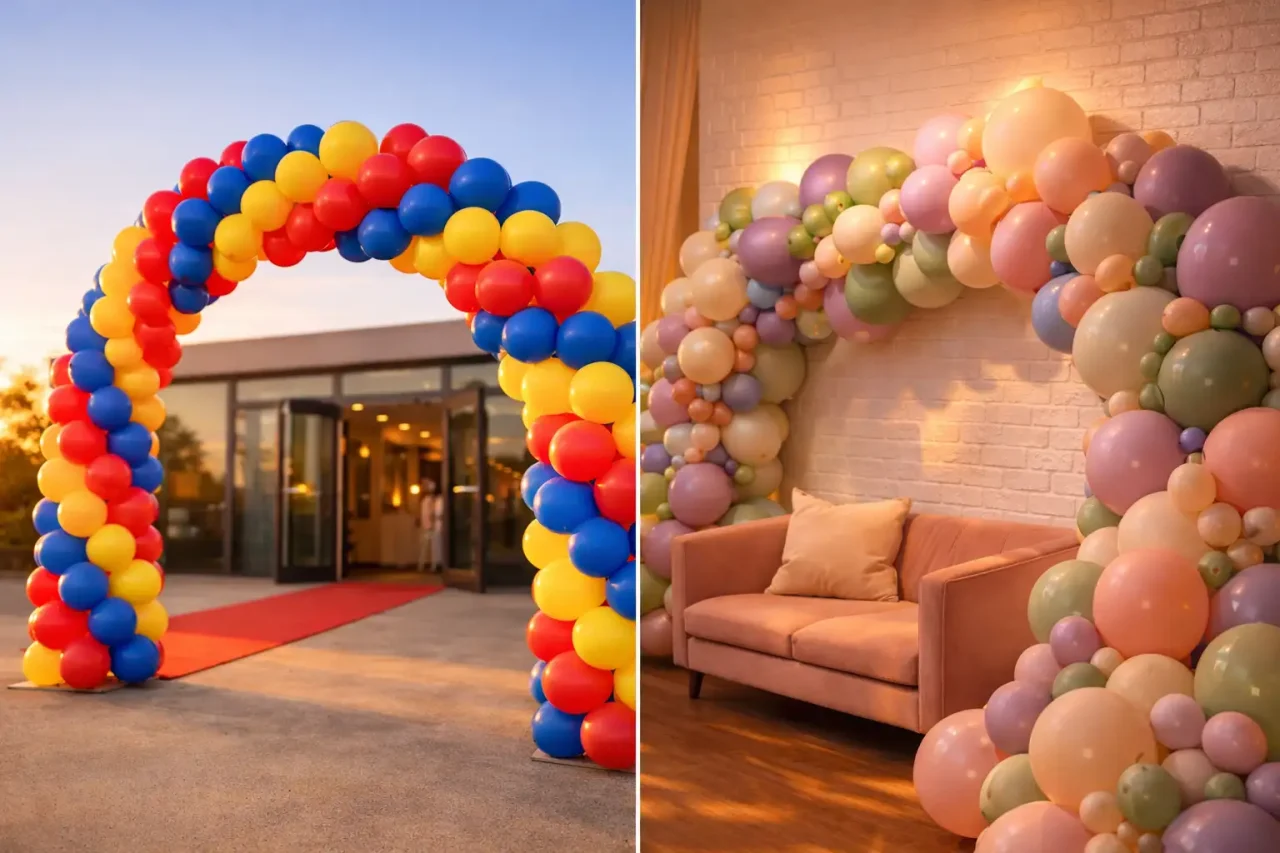
Why Ceiling Height Changes Everything
Most balloon arch tutorials assume you’re working outdoors or in a banquet hall with 12-foot ceilings. That’s a completely different design problem. When you have 8 feet of vertical space — which is 96 inches from floor to ceiling — every inch of balloon diameter matters.
A standard organic arch peaks at about 8 to 9 feet. That’s already too tall for your room. A full spiral arch with 16-inch balloons can peak at 10 feet or more. In an 8-foot room, that arch isn’t standing up. It’s either bowing against the ceiling or you’re cutting 2 feet off the top — which defeats the purpose.
The instinct is to build tall and dramatic. In a low-ceiling room, you need to flip that instinct. Go wide, not tall. Spread the visual weight horizontally across a wall or doorway instead of trying to create a towering centerpiece. An arch that spans 10 feet wide with a gentle 6.5-foot peak looks elegant and proportional. The same balloon count forced into a tall narrow arch looks like it’s fighting the room.
There’s also a practical airflow issue. Balloons pressed against a ceiling heat up faster, especially under recessed lighting. Heat means faster deflation and increased popping. A 6-inch gap between your highest balloon and the ceiling is the minimum. A 12-inch gap is better.
Recommended Arch Styles for 8-Foot Ceilings
Not every arch style works in a low-ceiling room. Here are the three that do, ranked by how well they handle the constraint.
1. Flat / Low-Profile Arch
This is the best option for 8-foot ceilings and the one professional decorators reach for first in residential settings. A low-profile arch has a gentle curve with a peak between 5 and 6 feet. It spans a doorway or wall section horizontally, creating a wide frame rather than a tall gateway.
The visual effect is a sweeping, organic canopy that draws the eye sideways. It photographs well because it fills the frame without competing with the ceiling. For a standard 6-foot-wide doorway, expect 80 to 120 balloons depending on density. For an 8-to-10-foot wall span, plan for 120 to 180.
Setup complexity is moderate. You need a frame or balloon strip anchored at both ends, with the midpoint held at peak height using a command hook, fishing line from the ceiling, or a freestanding support pole. The key is getting that midpoint height right — measure twice, attach once.
2. Column-and-Drape Style
Two balloon columns (5 to 6 feet tall) connected by a garland or light drape of balloons across the top. The columns do the heavy visual lifting. The connecting element stays flat and low — often just a single row of balloons or a balloon strip with scattered clusters.
This style works because the columns create height without needing the arch itself to peak high. The top connection can sit at 6 to 6.5 feet, well under the ceiling. Column-and-drape setups use 100 to 160 balloons for a standard doorway width. The columns account for about 60% of that count.
Setup is straightforward. Build each column on a base plate with a center pole, then connect them with a horizontal strip or fishing line. This is also the easiest style to transport — you can build the columns off-site and connect them at the venue.
3. Wall-Mounted Garland
Technically a garland, not an arch — but it solves the same visual problem and is the most ceiling-friendly option. (Not sure which to pick? See our wall-mounted garland alternative comparison.) A wall-mounted garland runs horizontally along a wall, above a dessert table, or across a photo backdrop area. It never needs to peak higher than where you mount it.
Mount height is entirely your choice. Most decorators place the garland center at 5.5 to 6.5 feet, which leaves comfortable clearance above and keeps the focal point at eye level or slightly above. For a 6-foot garland, plan on 50 to 80 balloons. For a 10-foot span, 80 to 130.
This is the simplest setup of the three. Attach a balloon decorating strip to the wall using command hooks at both ends and one or two in the middle. Inflate balloons, push them into the strip, fill gaps with 5-inch accent balloons. Start to finish, a 6-foot garland takes 30 to 45 minutes.
Balloon Size Guide for Low Ceilings
Balloon size selection is where low-ceiling arches succeed or fail. Here’s what works and what doesn’t in an 8-foot room.
| Balloon Size | Works in 8’ Ceiling? | Best Use | Notes |
|---|---|---|---|
| 5-inch | Yes — ideal | Gap filler, accent clusters, dense low-profile arches | Best size for adding texture without adding height |
| 11-inch | Yes — primary size | Main arch body, organic clusters | Keep arch peak below 7 feet when using as primary |
| 16-inch | Use with caution | Column bases, ground-level accents only | Do not use in the arch curve — too tall for the space |
| 24-inch | No | Not recommended for 8’ ceiling arches | A single inflated 24” balloon is 2 feet across — eats too much vertical space |
| 36-inch | No | Not suitable for any 8’ ceiling installation | Inflated diameter of 3 feet makes indoor use impractical |
The winning combination for low-ceiling arches is 11-inch balloons as the primary size with 5-inch balloons filling gaps and adding dimension. This mix gives you the organic, full look without pushing into ceiling territory. If you want some size variation, add a few 16-inch balloons at the base or column level only — never in the arch curve itself.
Venues That Typically Have 8-Foot Ceilings
If you’re reading this, there’s a good chance you’re decorating one of these spaces:
Residential living rooms and dining rooms. Standard residential ceiling height in the US is 8 feet. Newer construction sometimes runs 9 feet, but most homes built before 2000 are 8-foot ceilings throughout. Basement party rooms are often 7.5 to 8 feet.
Hotel meeting rooms and conference suites. Small breakout rooms and meeting spaces in hotels frequently have 8-foot ceilings, even when the main ballroom has 12 or more. Always confirm the specific room — don’t assume.
School classrooms and libraries. Most standard classrooms run 8 to 9 feet. Older school buildings can be as low as 7.5 feet with drop ceiling tiles. Measure the actual clearance, not just the structural ceiling.
Office break rooms and common areas. Commercial office spaces with drop ceilings typically land at 8 to 8.5 feet. The drop ceiling tiles are fragile — do not attach anything to them or lean a frame against them.
Small event suites and party rooms. Rental party rooms at community centers, apartment complexes, and restaurants often have standard 8-foot ceilings. These rooms benefit most from wide, low-profile arches that frame a head table or photo area.
Indoor Arch Setup Tips
Measure the actual ceiling height. Don’t assume it’s exactly 8 feet. Light fixtures, ceiling fans, sprinkler heads, and drop ceiling tiles can reduce your usable height by 4 to 8 inches. Measure at the exact spot where the arch peak will sit.
Account for the frame or support structure. A PVC frame or balloon column pole adds 1 to 2 inches at the top. A balloon decorating strip adds about half an inch. Factor this into your peak height calculation.
Use a balloon sizer for every balloon. Inconsistent inflation is noticeable in tight spaces. Over-inflated 11-inch balloons become 13-inch balloons — and those extra 2 inches push your arch closer to the ceiling. Size every balloon to the same diameter.
Build on-site when possible. Transporting a completed arch through standard 6-foot-8-inch doorways is difficult. Build at the venue. If you must transport, build columns and clusters separately and assemble on location.
Check the HVAC vents. Air conditioning vents near the ceiling create constant airflow that pushes lightweight balloons. Position your arch away from direct vent paths, or expect to re-adjust balloons after setup.
Use matte finish balloons indoors. Metallic and chrome balloons reflect overhead lighting and can create distracting glare in small rooms with low ceilings. Matte or standard finish balloons give a cleaner look in these spaces.
Anchor both ends securely. In an 8-foot room, a leaning arch doesn’t just look bad — it creates a ceiling contact point that leads to popping. Use sand-filled base plates, attach to furniture, or use command strip hooks on walls. Tape on carpet does not hold.
Pro Tips: Building Balloon Arches in Low-Ceiling Rooms
- Build a test cluster of 3–4 balloons at your planned peak height before committing to the full arch. If it touches the ceiling, lower the frame by 3 inches and test again.
- Organic arches with mixed 5-inch and 11-inch balloons create visual density without extra height. Use a 60/40 split: 60% 11-inch, 40% 5-inch.
- Photograph your arch from guest height (seated or standing) before the event starts. Ceiling proximity that looks obvious at your eye level often disappears in photos taken from 5 feet.
- For doorway arches in 8-foot rooms, leave a walk-through clearance of at least 6 feet 2 inches. Taller guests will instinctively duck under anything lower, which leads to contact and popping.
- Command strip hooks rated for 4+ pounds handle a balloon garland or light arch strip. For heavier PVC-frame arches, use screw-in ceiling hooks or freestanding weighted bases.
- Keep a repair kit on-site: 20 extra pre-inflated balloons in matching colors, a hand pump, and low-temp glue dots. Low-ceiling arches take more contact damage than tall ones.
Need an Exact Count?
The HICO balloon calculator handles low-ceiling configurations. Enter your arch dimensions and get an exact balloon count.
Use the Free Balloon Calculator